
Little Elm City Directory Collections
Little Elm historical research uses a shelf of related collections rather than one exact annual town directory. The local community books place names and families in town context. Denton directories and telephone books add date-specific address and notation clues. Newspaper and cemetery indexes help bridge a disappearance from a directory. The table separates sources that have actual Little Elm material from sources that cover nearby Denton or the county, so a reader does not mistake a locality reference for a complete household list.
| Collection | Years | Where held | Access |
|---|---|---|---|
| 112 Years in Little Elm Community | Published 1957; reaches into earlier community history | Little Elm Library history page and UNT Portal to Texas History | Keyword-searchable digitization, photographs, and names |
| A Salute to the History of Little Elm | 1983 | Little Elm Library reference and history page | Local business advertisements and early settlement map; verify the cited page image |
| Denton historical directories | 1923 and 1939 inspected digitized examples; local holdings from the 1930s | UNT Portal and Emily Fowler Special Collections | Names, relationships, student or role notation, telephone, and residence entries |
| Denton telephone directories | Back to 1918 | Emily Fowler Central Library guide | Telephone and address tracing; exact annual run is not stated in the guide |
| DRC newspapers and indexes | 1908 to current, with selected issues back to 1892 | Emily Fowler Special Collections | Birth, marriage, obituary, address, and event citations |
| TSLAC Denton microfilm | Collection-specific, including deeds, tax, probate, and poll-tax material | TSLAC, UNT, and Denton access points | On-site or reel-based historical record research |
No official source located a continuous Little Elm-only directory series or a confirmed continuous local criss-cross run. That gap is useful information. A historical Little Elm directory search should first test the community history and local indexes, then use Denton material when a person attended school, had a Denton address, or otherwise appears in that city’s records.
Little Elm Community Books and Names
The Little Elm History at the Library page directs researchers to Mrs. J. M. Harris’s 1957 112 Years in Little Elm Community and to Charlotte Johnson’s 1983 A Salute to the History of Little Elm. The first is digitized through the UNT Portal and makes photographs and local names searchable. The second includes local business advertisements and an early settlement map. A surname, place, or advertisement is a strong lead when it is retained with the page context.
The library history collection provides the local-history starting point for Little Elm historical directory research and the digitized 1957 community volume.
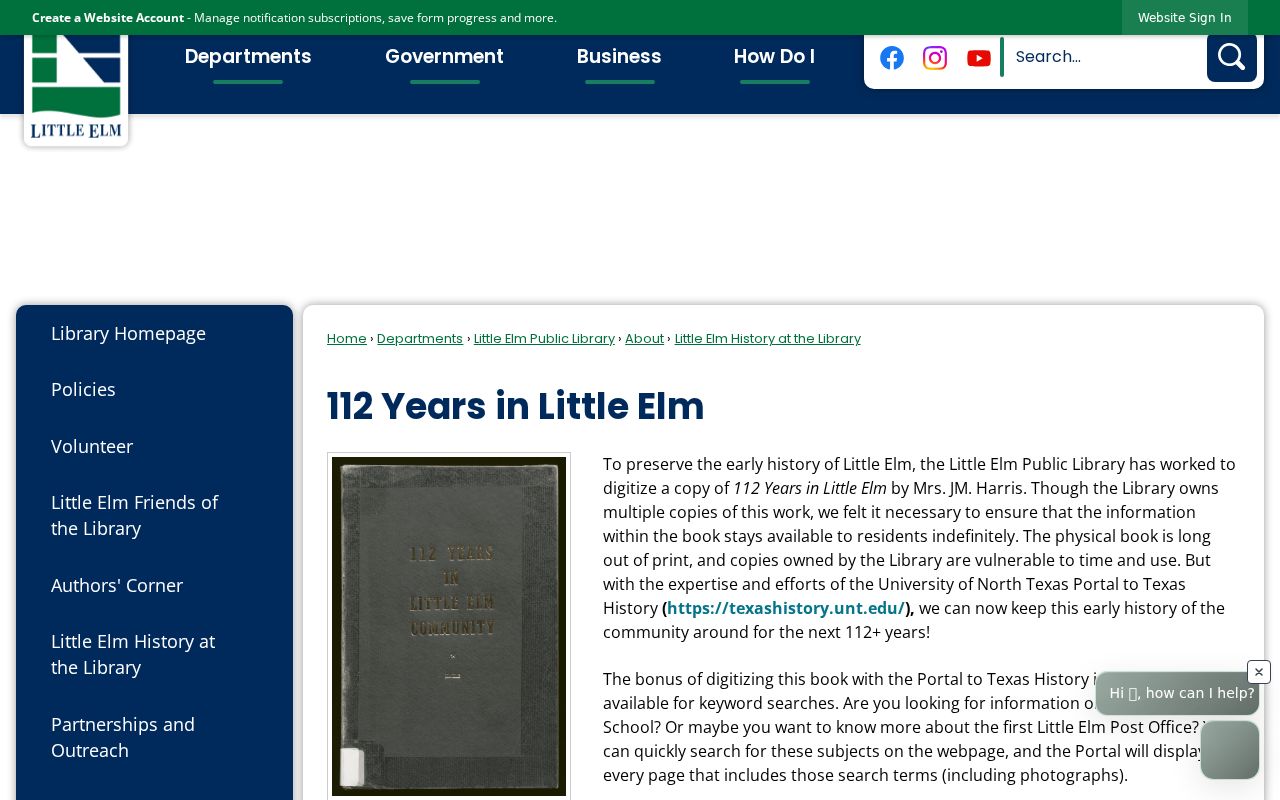
The community histories work best as context and search-term sources. They preserve early settlement labels, family names, businesses, photographs, roads, churches, and post-office context that can be tested in a newspaper citation, deed index, cemetery survey, or county record. A 1999 oral-history reference also preserves details of groceries, an ice house, a barber shop, churches, and a Halloween carnival from the 1930s through the 1950s. Those details should be tied to the cited collection and date, not promoted into proof of a person’s address.
Denton Directories Around Little Elm
Denton directory volumes are nearby-city resources, not a substitute for a Little Elm-wide annual register. Their value comes from what an actual page records. The inspected 1923 and 1939 examples include a name, residence, relationship in parentheses or widow notation, student or role information, and sometimes a telephone exchange. The 1923 book was published as the Retail Merchants’ Association’s Denton volume, while the 1939 volume identifies Mullin-Kille Company.
The 1923 Denton directory page in the UNT Portal shows the historical entry format used for a name, student or role notation, and residence field.
A printed directory entry is a snapshot from that edition. It may reflect a mailing or residence notation, a relationship clue, or a location in Denton, but it does not prove that a person lived in Little Elm or remained at the address afterward. The comparison between the 1923 and 1939 forms is useful because it shows why the original page, its date, and its abbreviation key must travel with the extracted name.
Read a Little Elm City Directory
Read each historic entry as a set of printed fields, not as a modern profile. In Little Elm research, the most common error is silently turning an old Denton entry or a post-office locality reference into a firm Little Elm residence. Preserve the edition year, the exact locality heading, the page, spelling, and all abbreviations. Then compare the entry to a second source that answers the same time-and-place question.
| Name line | May include initials, a former or shortened name, spouse in parentheses, or a widow notation. |
|---|---|
| Residence line | A house number and street can appear as a historical residence clue for that edition, not a current address. |
| Student or role notation | Some entries include a school marker, a trade, an organization, or another brief identifying description. |
| Telephone or exchange | Later directory sections can provide a number or exchange, which should remain linked to the printed year. |
| Owner-status notation | Some directory volumes include ownership notation; its meaning varies by publisher and must be checked in the edition. |
| Locality heading | Denton, a Little Elm post-office reference, or another historic locality can change the meaning of the same surname. |
- Criss-cross directory
- The street-order portion of a directory, used to move from an address to the entries printed for that year.
- Householder index
- An arrangement that points from a household heading to the appropriate name or address section.
- Abbreviation key
- The publisher’s explanation of the marks and short forms in that volume, usually worth capturing before reading entries.
Little Elm Telephone Directory Clues
Emily Fowler’s genealogy guide documents local telephone directories back to 1918 and Denton historical directories from the 1930s. A telephone volume can place a surname and address in a specific year, but the guide does not state a continuous Little Elm annual run or a confirmed Little Elm reverse-directory publisher. Check the year, locality, and section before treating the record as an address association.
Post-office listings are another useful but narrower source. Inspected 1895 to 1896 Galveston and 1927 Dallas post-office directory pages list Little Elm as a Denton County locality or post-office reference, not as a complete list of households. Historic locality variants matter as well: Lloyd, Hackberry, Dickson, Hilltown, rural-route descriptions, Denton County, and Little Elm may all appear in material from different periods.
Note: The Little Elm postal label or a historical post-office mention establishes the source’s place wording, not an incorporated-boundary finding or a complete resident list.
Use Little Elm Newspaper Citations
The Denton Public Library genealogy guide describes birth, marriage, and obituary indexes, local histories, cemetery surveys, church histories, yearbooks, and newspaper access. Its Denton Record-Chronicle citation practice retains issue date, section, page, and column, for example a citation formatted as issue date followed by section, page, and column. That structure lets another researcher find the same item rather than relying on an uncited surname.
Obituary index entries are ordered by surname and may use abbreviated names. Birth indexes can record first names, city, date of birth, gender, and citation, while marriage indexes are split by groom and bride. Search spelling variants before normalizing a name. Retrieve the cited issue through microfilm or a digitized newspaper route, note only the relevant date, relationship, and place clue, then compare cemetery and county sources.
Little Elm Research Room Sources
County historical material is split between the town and Denton repositories. The Denton County Research Room at the Courthouse-on-the-Square, first floor, holds early people and place material, cemetery and burial records, local histories, oral histories, Special Collections documents, photographs, and artifacts. Its published hours are Monday through Friday 9 to 4 and Saturday 11:30 to 2:30. Appointments are recommended but not required, and staff do not pull material in the last half-hour.
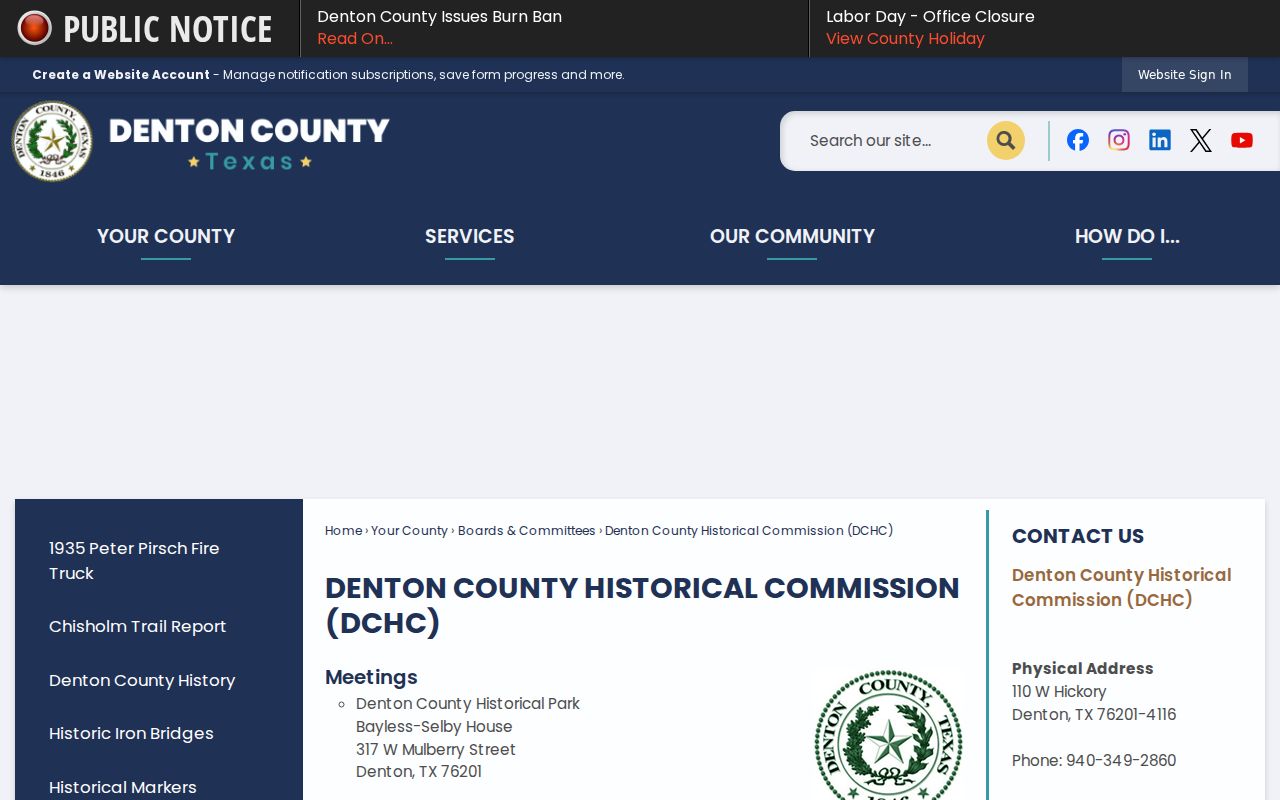
The Denton County Historical Commission is a county-government body under Local Government Code Chapter 318 with public meetings at the Bayless-Selby House.
Use the county Research Room for early county collections and the town archive for municipal agendas, annexation, plats, roadway, lakefront, zoning, and public-notice material. The town archive’s keyword, archive, board, and date search controls make it useful for municipal chronology. A county-seat archive and a town archive answer different questions, so their citations should remain separate.
Little Elm Directory History Timeline
Directory-like material has to be read alongside local record survival. Denton County was created in 1846. The Little Elm Post Office was established in 1852, and the small community included Lloyd, Hackberry, Dickson, and Hilltown before the modern town identity took shape. Little Elm incorporated in 1966. These dates help explain why an older person or place may be indexed under a settlement or post-office term rather than under a modern Little Elm label.
| Date or period | Directory research meaning |
|---|---|
| 1845 to 1852 | Early mail service and the Little Elm Post Office create historic name and locality terms for newspaper and postal searching. |
| 1875 | The Denton courthouse fire destroyed most county records, requiring substitute sources for earlier trails. |
| 1918 and 1923 | Telephone-directory access begins in the library guide, and an inspected Denton city-directory example provides a dated entry form. |
| 1930s and 1939 | Emily Fowler holdings include Denton directories from the 1930s, and the 1939 digitized example shows a different printed entry style. |
| 1957, 1966, and 1983 | The community history, incorporation, and later local history supply Little Elm context that can be tested against original records. |
Reservoir construction in the mid-1950s relocated or affected roads, structures, cemeteries, and residents. A missing place on a modern map may call for cemetery relocation material, oral histories, deeds, maps, and newspaper citations rather than a conclusion that the family left the county.
Trace a Little Elm Household
Household tracing works from a date-stamped entry toward corroborating records. The goal is to preserve a transparent chain, including a name spelling, edition, locality, printed address, source page, and the next record that supports or challenges the association. Census years are useful comparison points, but they do not replace the years between them. The local history, directory, newspaper, deed, and cemetery layers each carry a different kind of evidence.
- Search the Little Elm community history, local histories, and a date-appropriate directory or telephone volume for the surname and locality variants.
- Capture the edition year, page, precise spelling, residence notation, relationship mark, and abbreviation key before extracting any conclusion.
- Follow the surname through later and earlier volumes where held, noting each address or locality change rather than assuming it is the same person.
- Pair the directory year with a nearby census year, newspaper citation, cemetery survey, deed, tax record, or marriage and obituary index.
- When the address shifts or disappears, test the town archive, plats, annexation material, historic locality labels, and reservoir-relocation context before closing the trail.
A person can disappear from a directory because of a move, a death, a changed locality description, a missing volume, or an editorial omission. A dated index entry is therefore a starting point for a source trail, not a final identity decision.
Limits of Little Elm City Directories
Historical directories and local histories are incomplete by design. No official source found a public, complete Little Elm resident roster or a Little Elm-only continuous directory run. A Denton entry may identify a person in Denton, a student notation, or a nearby address without proving a Little Elm connection. Post-office listings identify a locality reference, not everyone who lived there. The most reliable result preserves the original wording and its date.
For a current address-keyed question, the Little Elm street directory uses tax, parcel, plat, and deed records that better match the modern address trail. Historical collections remain valuable because they show how a name, household, road, or locality was recorded at a particular moment.