
Little Elm Previous Residents by Era
A Little Elm address has two trails. The ownership trail is tied to the parcel and its legal description. The household trail is tied to an address, a locality name, or a dated directory entry. Denton County sources do not create one continuous list of people who lived at every address, so each era needs the source that can actually speak to it. The present parcel record is a useful starting point, but it must be kept separate from a historical household finding.
| Record source | Period covered | Repository or route | Address-history clue |
|---|---|---|---|
| County deed records | 1854–1855; 1875–1902 in the TSLAC guide | Denton County Clerk and TSLAC reels | Conveyances, parties, and legal descriptions |
| Direct and reverse deed indexes | 1875–1903 | TSLAC reels 1302133–1302135 | Grantor and grantee paths through an earlier chain |
| County tax rolls | 1846–1910 | TSLAC microfilm | Taxpayer, property, and tax-year leads |
| Directories and telephone books | Telephone holdings back to 1918; city holdings from the 1930s | Emily Fowler Special Collections and UNT | Year-specific address and household notation |
| DRC and local-history sources | DRC 1908–current, with selected issues back to 1892 | Library, Research Room, and local collections | Moves, family, place, obituary, and event clues |
For a recent transfer, begin with the parcel account and the recorded instrument. For an earlier Little Elm household, use the directory or newspaper date as a checkpoint, then test it against a deed, tax roll, probate item, or census record. TSLAC, the Denton Public Library, and the county Research Room provide the historic alternatives when an online screen ends. The County Clerk’s portal, recording counter, mail and copy routes, phone assistance, library holdings, TSLAC microfilm, and a Texas Public Information Act request for existing administrative material are separate access channels, not substitutes for one another.
Note: An address result can identify a parcel or mailing field, while a dated household record may identify a different kind of connection.
Legal Keys in Little Elm Records
Use the current site address to open the Denton County Tax Web search, then retain the account number and full legal description. Tax Web separates Property Location from Owner Address. That distinction matters because the latter is a mailing field and cannot establish that its addressee lived at the Little Elm property. DCAD’s parcel map can add the property identifier, subdivision, block, lot, and map context. A unit number, direction, street suffix, and subdivision name should remain with the search notes when duplicate street names are possible.
- Legal description
- The parcel’s formal land description, often using a subdivision, lot and block, survey, or tract. It is the durable bridge when a street address changes.
- Grantor
- The party conveying an interest in a recorded instrument.
- Grantee
- The party receiving that interest in the instrument.
- Chain of title
- A sequence of conveyances connected by the same parcel description, not merely a run of similar names.
A plat can connect an old tract description to a later lot and block. The town’s plat material explains that plats establish subdivision, lot, block, street, utility, drainage, and related information. Search the Little Elm archive for plats, annexation, road, and Planning and Zoning material when the address and legal description no longer appear to match. No complete public historical street-alias table was located, so an unanswered translation should be recorded as a gap.
Little Elm Records for Past Residents
The Denton Official Records advanced search offers fields for party, instrument date, document number, legal description, book, and page. Those controls make it possible to search the parcel’s description as well as a name. Record both the instrument date and the recorded date. They are not interchangeable. An index hit is not the same thing as the full deed image, and a deed only documents a conveyance. It does not prove that a named party occupied the address.
| Advanced-search field | How it helps an address trail |
|---|---|
| Party name | Tests a grantor or grantee after the parcel connection is known. |
| Legal description or subdivision | Keeps the search tied to the tract, lot, block, or recorded subdivision. |
| Instrument and recorded date | Separates when an instrument was signed from when it entered the public record. |
| Document number or book and page | Locates the cited index entry or recorded instrument again. |
The official advanced-search screen shows the separate party, date, document, legal-description, and book/page controls used to build a Little Elm previous-residents trail.
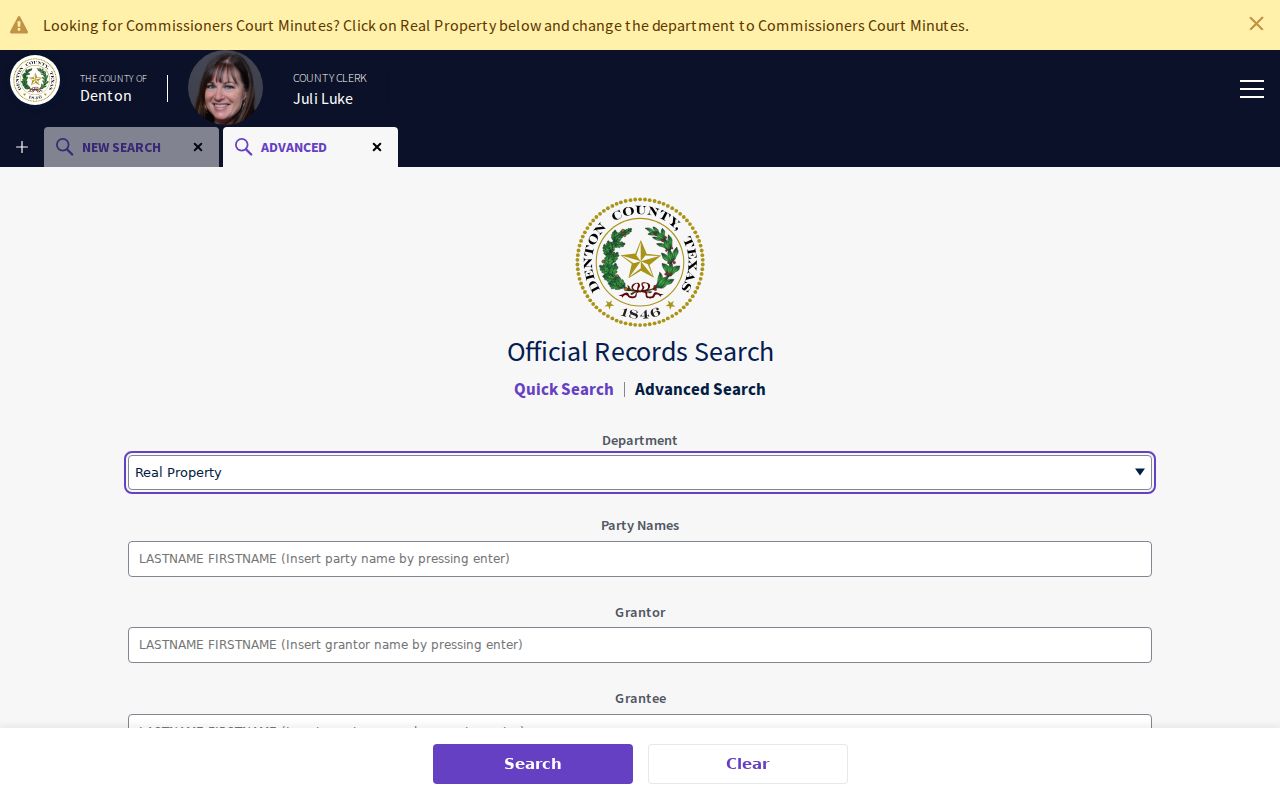
Search terms should be copied from the parcel and instrument instead of being guessed from a modern street line. The portal’s visible notice says certified through 09/02/2021 Department, so note that limitation with the date of the search. Images may require registration or payment. The Recording Division counter, mail or in-person copy route, and phone help remain practical fallbacks when an image or older item is not available in the online view.
Follow a Denton County Deed Chain
Work backward from the latest transfer by matching the legal description at every step. In the usual chain, the buyer on the current deed becomes the party to search for an earlier purchase, and the seller supplies the next earlier connection. Do not treat a similar surname as a match without the lot, block, tract, survey, or plat reference. Releases, assignments, easements, judgments, and later conveyances can clarify why a name appears without being a sale of the home.
- Find the exact property location in Tax Web and save the account number, site address, and legal description.
- Use the legal description, document number, or current party in the County Clerk index to locate the latest conveyance.
- Copy the grantor, grantee, instrument date, recorded date, document number, and any subdivision or plat reference.
- Search the prior party in the opposite direction and compare the legal description before adding another link to the chain.
- When online material reaches an older gap, move to the direct or reverse indexes, deed books, TSLAC reels, library assistance, or the Research Room.
The process is parcel first, then instrument, then party, then prior instrument. A title professional is the proper route when a legally reliable title opinion is needed. For historical Little Elm research, a chain with a documented break is more useful than a smooth story built from assumptions.
Historic Reels for Little Elm Past Residents
TSLAC’s Denton County microfilm guide is the bridge to older direct and reverse deed indexes. It lists deeds for 1854–1855 and 1875–1902, plus direct and reverse indexes for 1875–1903. The listed reels are 1302133, 1303134, and 1302135. The same historical set includes tax rolls, marriage records, probate material, district civil minutes, and poll-tax lists, all of which can provide a date or name to test rather than a replacement for a deed.
The TSLAC Denton County reel listing documents the historic deed and reverse-index material that supports a Little Elm past-residents search.

Use the direct index to follow one party and the reverse index to test the other direction, then cite the reel and index page with the result. TSLAC collection access is on site, and its staff do not search or transcribe by phone or scan and email. The library, TSLAC material, and the courthouse Research Room therefore matter when a historical answer cannot be read online.
Note: Preserve the reel, page, spelling, and date range so another researcher can revisit the same historic entry.
Little Elm Records After the Courthouse Fire
Denton County’s 1875 courthouse fire destroyed most county records. This is not a reason to fill a missing deed link with a guess. It is a reason to change the proof strategy. The TSLAC guide itself flags a missing Volume 61 and later unfilmed portions of Volumes 75 and 78. A stop in the index may reflect the fire, a filming omission, a change in description, or a record held elsewhere.
Test the break with county tax rolls from 1846–1910, probate appraisals and minutes, wills, marriage records, DRC citations, cemetery surveys, local histories, and the research-room collections. Historic Little Elm may also be indexed as Lloyd, Hackberry, Dickson, Hilltown, a rural route, or simply Denton County. Keep the locality spelling beside the modern parcel relation. That small detail can make a future search possible without pretending the locations were identical.
Note: A missing historical record is a documented limitation, not proof that a person or property connection never existed.
Household Sources for Little Elm Previous Residents
Ownership is only one part of a past-address question. Emily Fowler Special Collections lists telephone directories back to 1918 and Denton city-directory holdings from the 1930s. Its guides also point to federal censuses through 1940, newspaper indexes, cemetery surveys, local histories, church histories, yearbooks, and microfilm. No continuous, Little Elm-only reverse-directory run was verified. Treat a directory line as a dated snapshot, then corroborate it with a second source.
For the directory collections themselves, use the Little Elm city directories route. A sound household flow is simple: find the street and house in the year-specific volume, preserve each printed name and notation, check the surname in the alphabetical portion, pair the date with the relevant census period where available, and compare the result to deed, tax, newspaper, cemetery, or probate evidence. The Denton Record-Chronicle indexes should be cited by issue date, section, page, and column before drawing a family or place conclusion.
Obituaries and cemetery material can close a trail after a person left the address, but each serves a different purpose. An obituary is a reported notice, a cemetery survey is a burial clue, and a county death record follows separate access rules. Keep them as separate evidence types. The Little Elm Library’s 1957 community history, the 1983 local history, and county oral histories can suggest names, businesses, or settlement labels to test against formal records.
When Little Elm Places Moved
Lake Dallas and the Garza-Little Elm Reservoir changed the local landscape. Roads, structures, cemeteries, and residents were relocated or affected, so an old place may not fit a current parcel map. When a chain or obituary names a vanished place, preserve that wording and search the library’s cemetery and relocation material, oral histories, and local newspapers. The 1885 Library of Congress Sanborn sheet is for Denton, not Little Elm. It can show map conventions, but it cannot fill a Little Elm house-history gap.
The 1957 community history and a 1999 oral-history reference preserve place clues such as stores, an ice house, a barber shop, churches, and a Halloween carnival. Those are leads to verify in contemporary records, not proof that a particular person lived at a parcel. Town archive searches for annexation, plats, zoning, roadways, lakefront material, public notices, and capital projects can explain a changing address context. The 2021 annexation map is a planning reference, not a legal survey.
Lawful Limits for Little Elm Past Residents
Historical address research is best kept to family history, estate and heir questions, property history, civic records, or personal curiosity. Owner, mailing, parcel, and historical household fields answer different questions. Sensitive details should not be collected or republished simply because a record can be located. The Texas Attorney General’s Address Confidentiality Program and election-address protections can restrict some address information, and a public display may be incomplete by design.
Lawful use. Use Little Elm previous-residents research for legitimate personal or historical purposes. Do not use record findings to watch, harass, intimidate, or harm a living person; Texas Penal Code §42.072 addresses stalking.