
Little Elm Resident Lookup Coverage
Little Elm has no official all-resident roster. The useful route for a Little Elm record is to ask one narrow question at a time and use the record held for that purpose. A property record can show a tax account and displayed owner, mailing, and situs fields. A deed index records parties and a legal description. A voter result concerns registration status, while a court result concerns a case. The Denton County Tax Web, county Clerk, DCAD mapping tools, and state systems should remain separate sources in the notes. That separation prevents a tax owner, mailing address, or recorded party from being treated as a confirmed occupant.
| Record | Question it can answer | Custodian or route | Access boundary |
|---|---|---|---|
| Tax account | Displayed owner, mailing field, situs field, and account details | Denton Tax Web and DCAD | Online, counter, or phone; online date scope is not posted. |
| Deed index | Recorded parties, instrument date, recording date, and legal description | Denton County Clerk | Online, counter, or mail; portal notice and image access limits apply. |
| Parcel GIS | Parcel geometry, map jurisdiction, subdivision, and location context | DCAD, county, or town GIS | Online map layers; refresh dates are not fully posted. |
| Voter status | Registration status, county, precinct, and permitted identifiers | VoteTexas and Denton County Elections | Online status route or authorized request; protected-address rules apply. |
| Court docket | Case parties, cause number, events, orders, and disposition | Municipal, county, or statewide court route | Portal, counter, or written request; sealing and court rules apply. |
| Vital or historical index | Event, relationship, or dated household clue | Clerk, DSHS, library, or archive | Copy eligibility and historical-public-opening rules vary. |
Begin with the exact address only when its role is known. A parcel and a tax bill are not the same object. In Little Elm, preserve alternate spellings, middle initials, suffixes, and an approximate date before searching when only a name is known. For a historical address trail, the Little Elm City Directories collection offers a different kind of dated clue than a current county record.
Little Elm Resident Record Roles
Little Elm namesakes are common enough to make role checking essential. A county court party may be a plaintiff, defendant, guardian, estate representative, or attorney. A deed grantee may be an entity, trustee, or estate. A voter record can show a status that is suspense or protected. A town permit or a professional credential concerns a regulated transaction or credential, not a home. The most reliable Little Elm resident lookup keeps the role beside the name and compares it with an address, parcel, date, spouse or relationship clue, or another independent source type.
The town adds a local jurisdiction check. Its published guidance says that a post-office or driver-license Little Elm label does not alone prove an address lies within town limits. Compare the municipal boundary layer, tax jurisdiction, parcel location, and postal line before calling a location a Little Elm address. A town facility may even use a nearby postal city line. This is why a clean match is stronger when the source date, field label, and geographic role are all retained.
Note: Treat a matching name as a lead until two independent record types agree on the relevant person, place, and time.
Little Elm Court Lookup Routes
Little Elm Municipal Court and Denton County courts do not share the same route. The town court handles Class C misdemeanors, traffic, and municipal ordinances, and no public town name-search portal was located in the research. Denton County links its Public Access system and statewide re:SearchTX route, though the county public-access address redirected during inspection. For district-level Little Elm matters, use the District Clerk request form. Judicial records follow Texas Rule of Judicial Administration 12 rather than the ordinary Public Information Act process.
The Denton County Public Access landing route is shown below. A portal loop or no-result screen is an access outcome, not proof that the court has no Little Elm file. Keep a Little Elm name search narrow by adding the county, court, case type, date range, and known party role when the live interface permits it.
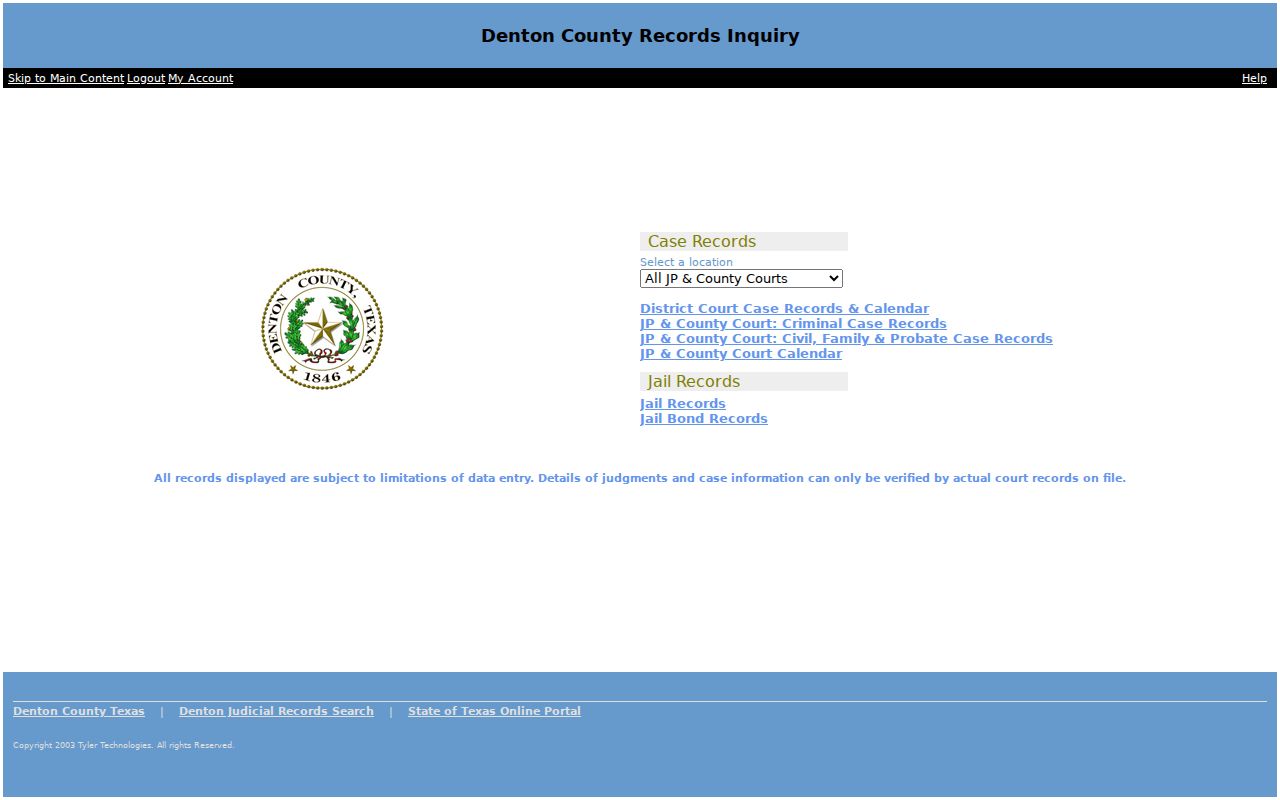
Use the landing page to confirm the official route, then obtain a filing relevant to the Little Elm question from the proper clerk when the case number and access rules support it.
A court result is most useful when copied as a small record inventory, not as a broad personal profile.
| Cause number | The court’s case identifier, retained exactly. |
|---|---|
| County and court | The forum that held the file and its jurisdiction. |
| Party and role | The person’s role, such as party, guardian, estate, or attorney. |
| Case and event dates | Filing date, docket-event chronology, and order or document dates. |
| Disposition and redactions | What the docket says, while respecting sealed, juvenile, or protected material. |
Verifying a Little Elm Resident
Verification works best when it moves from a narrow Little Elm address or dated record to a second independent source. Start with the property location, not the owner mailing field, when the question concerns a parcel. Keep the account number and legal description with the search notes. Then compare the name in the deed index, a permitted voter-status route, or a court or vital record only when that record type relates to the question. A resident lookup should end with a limited conclusion such as historical, index only, or current as of the search date.
- Normalize the surname, given name, middle initial, suffix, and likely spelling variants.
- Check a property location or parcel record and retain the account, situs, mailing-field label, and legal description.
- Search the County Clerk index for the parcel party in the Little Elm record and compare recorded dates and parcel language.
- Use the relevant court, voter, or historical index for corroboration, then record what that source cannot establish.
These terms keep the evidence trail readable when more than one office is involved.
- Docket
- A court’s chronological list of filings, events, and orders in one case.
- Index and image
- An index lists fields that help locate a record; an image is the document view, which can have separate access or fee rules.
- Certified copy
- A copy issued by the custodian with its certification, requested only through the office that holds the record.
Little Elm Vital Record Windows
Little Elm vital records are not a shortcut to a current address. Denton County provides an eligibility-based route for certified birth and death copies, while the County Clerk maintains marriage records and the District Clerk is the route for certified divorce decrees. Texas DSHS distinguishes verification letters from certified county copies. The state public-opening rule is 75 years for birth records and 25 years for death records, subject to statutory exceptions and record-specific restrictions.
For Little Elm historical research, county marriage records reach back to 1875, and the Denton Public Library holds newspaper, obituary, birth, marriage, cemetery, and local-history indexes. County notes list a first birth copy at $23 and a first death copy at $21, with different fees for additional death copies and other vital products. Check the Denton County birth and death route for current eligibility, office, and application details before ordering.
When an eligible copy is unavailable, a dated obituary, marriage index citation, church history, cemetery survey, or newspaper item may still support a Little Elm historical question. Each is evidence of an event or appearance, not a present-day location finding.
Little Elm Resident Records Fallback
When an official Little Elm interface is unavailable, preserve the exact search attempted and move to the custodian’s documented alternative. County tax and GIS research can continue by counter or phone. Clerk records can use the portal, recording counter, mail, or copy route. Court files can require a clerk request. Library, archive, and TSLAC sources are the historical fallback. No official public cross-database identity resolver was found, so separate searches remain more defensible than trying to assemble a single person file.
For an existing Little Elm town or county administrative record, the Texas Public Information Act allows a defined written request. Identify the record category, date range, address or legal description, desired format, and request an estimate. The Comptroller guidance says an estimate is required when charges exceed $40, and a requestor generally has 10 days to respond. Courts are different: their records follow Rule 12. Ask for releasable fields and accept redactions rather than requesting a newly compiled resident list.
Note: Record the Little Elm official URL, date searched, custodian, access channel, and any stated gap before trying a second route.
Legal Limits for Little Elm Resident Lookup
Some Little Elm information is protected by design. Texas Election Code section 13.004 protects Social Security, Texas driver-license, DPS identification, and specified phone or address information. Protected voter categories may suppress a residence field. The Texas Attorney General Address Confidentiality Program supplies a substitute mailing address for qualifying survivors and is not a general remove-my-name option. Vital records, juvenile matters, sealed or expunged files, and protected court material have their own rules as well.
When a Little Elm displayed field appears wrong or unsafe, return to the custodian. Ask whether the field is public, confidential, or a vendor-indexed copy, then use the office’s correction, suppression, statutory-redaction, or confidentiality process if it applies. Do not fill a missing address through inference from a mailing field, postal label, or another person’s record. The underlying office controls its source record and its legal limits.
Lawful use. Use Little Elm records for personal, lawful research and source verification. Do not use them to stalk, harass, intimidate, or harm anyone.
Little Elm Resident Lookup Notes
A short Little Elm audit trail makes a correction possible later. The resident-search evidence ladder calls for a name variant, source type, exact record date, address or parcel key, role in the record, custodian, source URL, access status, corroboration, and conclusion limit. The conclusion should describe the evidence, not overstate it. A tax account can be labeled as a displayed tax-owner result; a docket can be labeled as a named party record; a historical directory can be labeled as a dated snapshot.
Use a confidence label that matches the evidence. High confidence requires an exact name, address, and date with agreement from two custodians. Medium confidence has one official index plus a matching support detail. A name alone, a postal-city string, or a result without an address is low confidence. Mark each note historical, current as of the search date, index only, or restricted and not verified. That language keeps Little Elm record research useful without turning partial public data into an identity verdict.